On April 22, 2006, about 300 airmen formed up near Isis Avenue and marched down El Segundo Boulevard. The base honor guard and Lieutenant General Michael Hamel were at the front, and they were escorting a rock, the WDD Rock, from the part of Los Angeles Air Force Base being given up to its new spot in a courtyard at the rest of the base. The ground they left is now ThreeSixty South Bay.
William Lyon Homes built the community in the 2010s, but the homes started as part of the payment for the newer Air Force buildings next door. The land was traded for those buildings, and that trade decided how many homes went up and how long the site waited for them.
Seven office buildings in another city
Before ThreeSixty, the site was known as Los Angeles Air Force Base Area A, at 2400 to 2800 E. El Segundo Boulevard. In 2003 it measured 39.24 net acres and had been under federal control since the 1940s. It held six two-story office buildings and one six-story office building, about 835,000 square feet in all, surrounded by surface parking.
The land was not in Hawthorne then. The city's Pacific Glen Specific Plan, adopted July 16, 2003, describes the site as part of the City of El Segundo. A reorganization approved by the Local Agency Formation Commission was expected to move it into Hawthorne that September. ThreeSixty's Hawthorne address dates from that change.
A base that paid for its buildings with land
The trade started with old buildings. The Air Force's own history of the installation says that by the 1990s the buildings in both Area A and Area B were old, deteriorating and seismically unsafe. A team led by Col. Dieter Barnes, formed in April 1997, concluded that paying for new buildings through the standard Military Construction budget would cost too much to win approval and would take more than 12 years to finish.
Instead, the team proposed giving the valuable Area A land to a real estate developer in exchange for new base buildings on Area B. It called the plan the Systems Acquisition Management Support Complex, or SAMS. The Air Force signed the SAMS contract on January 23, 2004, and its history calls it the first time the U.S. government traded government land for new facilities.
The base got two four-story office buildings, numbered 270 and 271, and a Child Development Center, Building 281. The Air Force credits the deal with saving more than $130 million in construction costs, plus $3.5 million a year in operating and maintenance costs. Before the contract was signed, the Los Angeles Times reported in March 2003 that the full deal covered 58.7 acres in three parcels: about 42 acres at the base, 13 acres elsewhere in Hawthorne and 3.7 acres in Sun Valley, in exchange for 560,000 square feet of new facilities.
Why the home count landed where it did
In that deal, the land had to earn enough to pay for the buildings. A developer group took that on. The 2003 plan names the applicant as SAMS Venture, L.L.C., a partnership of Kearny Real Estate Company, Morgan Stanley Real Estate Fund IV and Catellus Development Corporation. The Daily Breeze reported in November 2003 that the modernization cost $115 million.
According to that Daily Breeze story, the first proposal for Pacific Glen put 975 homes on the 39 acres. After the City Council and the community pushed back on density, the developers cut it to 750. The developers told the paper that number came out of nine months of meetings with the Hollyglen Homeowners Association, Hawthorne city staff and their consultants, the Planning Commission and the City Council, and that it was the lowest count that could still cover the $115 million cost of the new base buildings.
The calendar was tight as well. The same Daily Breeze article reported the developers' view that the contract had to be signed by the end of 2003 or very early 2004, before the Pentagon paused new contracts ahead of the base-closure announcements expected in mid-2005. The contract was signed that January.
The handover, then the wait
The Air Force finished moving out of Area A in April 2006. At a "Farewell to Area A" ceremony on April 7, Lt. Gen. Hamel handed a large symbolic deed to the property to Hoonie Kang of the Kearney Real Estate Corporation, and the honor guard lowered the U.S. flag at Area A for the last time. Two weeks later came the march down El Segundo Boulevard with the WDD Rock. After that, the Air Force stopped using the names Area A and Area B, because the whole base was now in one place.
The 2003 plan's schedule called for demolishing the Air Force buildings in early 2006, breaking ground on housing by mid-2006 and finishing the homes in 2007 to 2008. The homes came several years later. William Lyon Homes' annual report for 2009 lists "360 South Bay" in Hawthorne, with first deliveries at the Flats and the Courts planned for 2010. The builder's 2010 report shows the project still being built in phases, with first deliveries for its product types spread across 2010, 2011 and 2012. In the same filing, the builder described the housing downturn that began in 2006 as a period of weak demand, falling prices and tight mortgage credit across its markets.
From Pacific Glen to 360 @ South Bay
The Pacific Glen name stayed on the zoning after the homes got a new name. On January 8, 2013, the Hawthorne City Council considered Ordinance No. 2035, a request from William Lyon Homes to amend "the Pacific Glen Specific Plan" so that single-family detached homes could be built in the Garden Court section of "the 360 @ South Bay development." The city also recorded the total buildout dropping from 625 homes to 610. That is 365 fewer homes than the 975 first proposed in 2003.
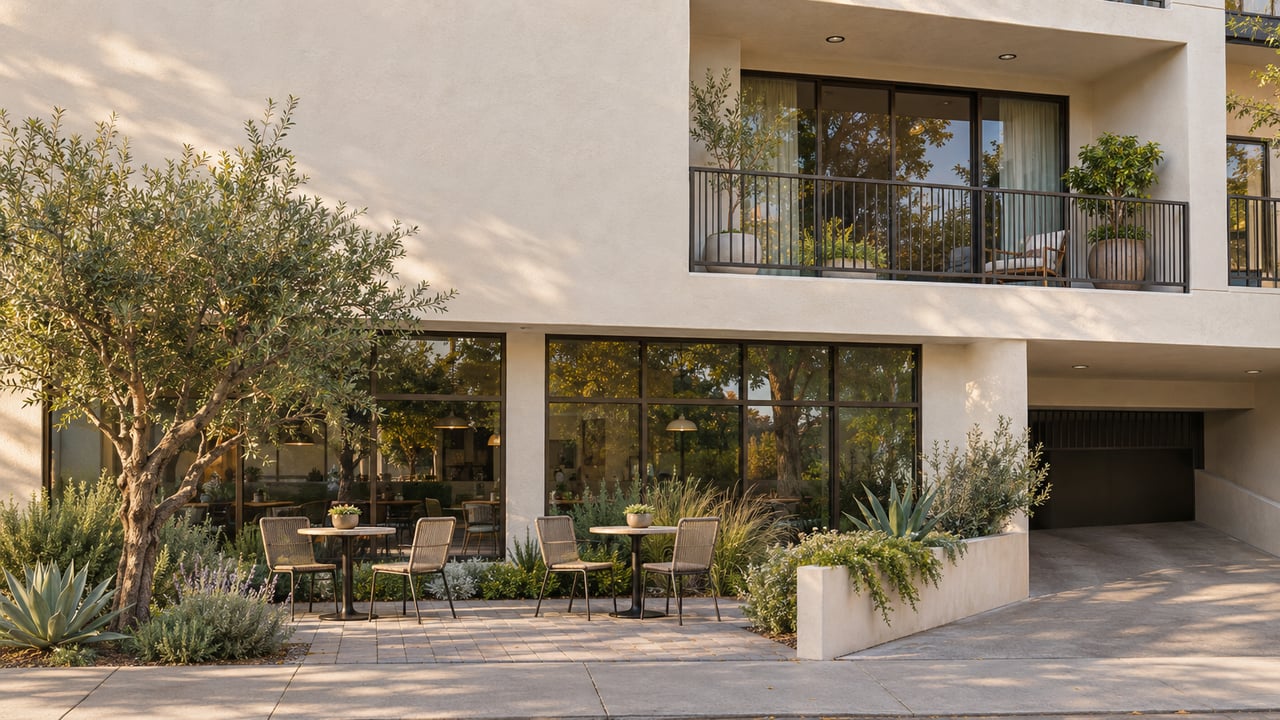
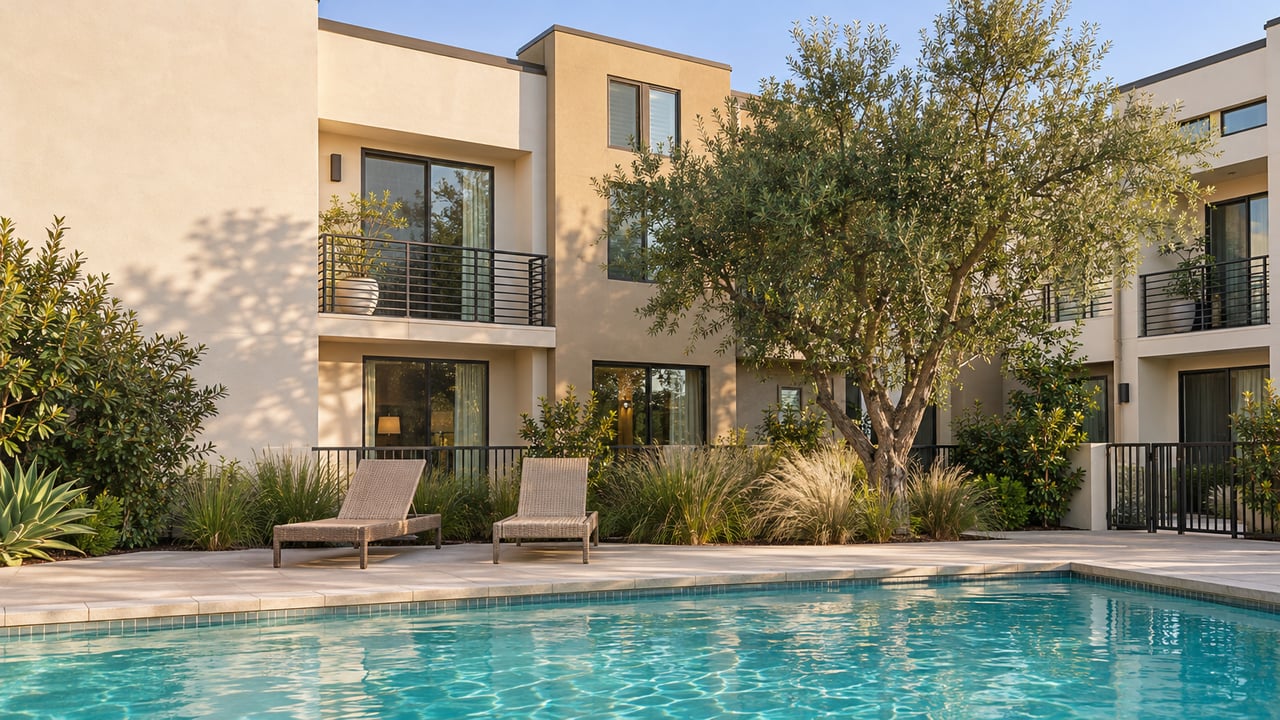
By then the builder was selling the community by collection. A William Lyon Homes release from September 2013 listed The Townes, The Flats, The Row, The Lofts and The Terraces, with The Terraces pre-selling at expected prices starting in the mid-$700,000s. The builder's grand-opening announcement had priced Flats studios from $374,990 and Court townhomes from $464,990, and it described The Center, the shared hub with pools, a spa, sports courts, a gym, a lounge, a banquet room and a playground.
The neighborhoods inside the gate took shape as homeowners moved in. In December 2014, FirstService Residential announced it had been chosen to manage The Terraces at Three Sixty South Bay Association, a 93-home sub-association within the larger Three Sixty South Bay Association. Under that structure, the Terraces homes share The Center with the rest of the community. If you are comparing those collections side by side, our home style guide lays out how the formats differ.
The neighbor that came out of the same deal
Area B was described in 2003 as sitting immediately northwest of the Pacific Glen site. It is still an active base. The installation's official About Us page describes Los Angeles Air Force Base as home to Space Base Delta 3, the host unit, and Space Systems Command, which shares the base. It calls it the only active-duty installation in greater Los Angeles, with more than 7,000 assigned personnel.
The buildings the homes paid for are Buildings 270, 271 and 281, put up under the SAMS contract. The WDD Rock sits in the base courtyard, where the 2006 march took it from the land ThreeSixty now covers. For more on the streets around the gate, see our Hawthorne neighborhood page.
Matthew Barry has called ThreeSixty home since 2013, around the time the collections described above were opening. If you're curious how your own section of the community fits into this history, or what the Garden Court change meant for the homes there, 360 South Bay is glad to talk it through. Get in Touch.